
Stage 5
Continuous improvement
Stage 5
Continuous improvement
Golden Rules
To ensure continuous improvement of the service, the following rules and principles must be observed:
01. Define the appropriate metrics (KPIs), which will characterize the qualitative and quantitative operation of the process.
02. Define the methodology and tools for monitoring the process.
03. Adequately define the user feedback mechanism so that it can receive reliable and useful feedback from users, with the aim of identifying the problematic points of the digitised process and improving it.
In ensuring the Continuous improvement of a service can help and the following scheme
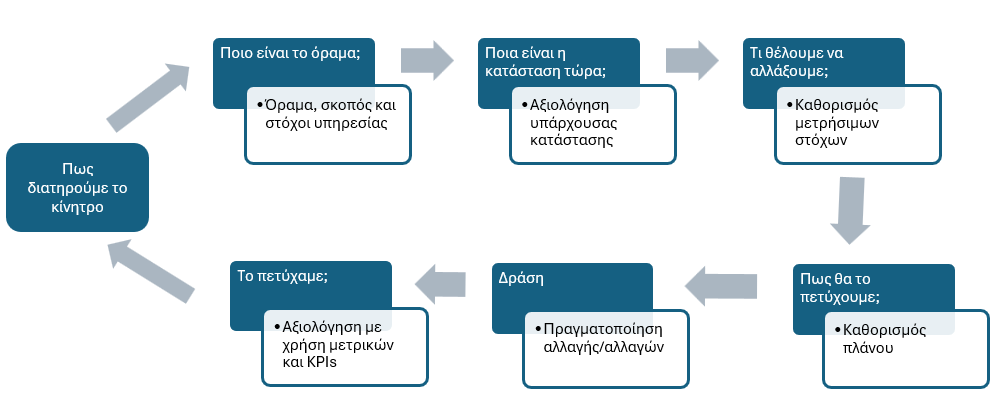
What are the actions;
This action aims to evaluate one service at a time, at regular intervals (determined by the body), in order to understand whether it works properly or not. That is, identifying areas where the objectives set are not met, errors in its procedures and generally whether this service is effective and efficient. This can be achieved through real-time evaluation and monitoring of user feedback. Full knowledge of the service is essential for the successful completion of this action.
This action aims to understand and align the improvement processes carried out within a service with the needs of citizens/businesses. Setting specific goals is a very important part of the process as it ensures the success of the stage. The more specific and targeted an intervention is made, the greater the likelihood that it will be effective.
This action aims to select specific metrics and indicators (KPIs) to monitor the performance and effectiveness of the service. Also, this action identifies the data to be collected based on the target set in the above action. These data may be data relating to the performance of the service, user satisfaction, etc. Correctly selected data helps to make appropriate decisions about where efforts should be focused, but it also helps to understand later whether improvements have worked or not.
This action aims to collect real data on the issues selected to be measured in a previous action, then process the raw data and convert it into a more useful form. Finally, through their analysis, the causes of the problem, recurring patterns, opportunities for improvement, etc. are identified.
This action aims to share the findings with stakeholders in order to create recommendations to address the problems encountered.
This action aims to prepare and execute the improvement changes in the service. It is the energy that comes to utilize all the knowledge collected in the previous actions in order to solve the problem. If necessary, new metrics and indicators (KPIs) are proposed here to allow for the monitoring of the changes made.
This action aims to monitor the improvements made in the service to ensure that the desired results are now achieved. This can be achieved by monitoring the set metrics to draw conclusions about how the service works after the change(s) have been implemented, by receiving feedback from users to draw conclusions about their satisfaction after the changes. Finally, the documentation of the final results, the mapping of good practices and the sharing with the rest of the organization (public) are considered useful.
Useful material
Each public body has unique priorities, and we provide useful resources from international frameworks and best practices to help teams develop their strategy.
The “Vos démarches essentielles (VDE)” programme of France
observatoire.numerique.gouv.fr
The FItSM framework
Proposed activities related to: Continual Service Improvement Management (CSI)
fitsm.eu
How can we assess that we have taken all the actions required to continuous improvement the digital service?
You can use the following evaluation questions:
E5.1.1 Are alternative ways of receiving feedback and evaluation from citizens/businesses defined? (except for the evaluation form)
E5.1.2 Are synergies between users and implementer foreseen to receive feedback?
E5.2.1 Are A/B testing operating scenarios foreseen for the UI?
E5.2.2 Is there a documented change management process in the implementing body? (change management)
E5.2.3 Have the required staff trainings been defined?
E5.3.1 Are useful reports designed for the use of the service?
E5.3.2 Have any problems arising from the automatic monitoring mechanisms of the service been recorded?
E5.3.3 Is there a mechanism for recording and analysing the level of user satisfaction with the experience of using the service?
E5.3.4 Are quantitative benchmarks set for the need to redesign/re-implement the service?
What we aim to achieve with continuous improvement of the service?
With the successful implementation of this phase we aim to:
01. Maintaining the overall health of the service based on data rather than simple assumptions.
02. Continuously meeting the needs of consumers (citizens/businesses).
03. Ensuring the maturity of the service.
04. Improve all aspects of the service.
05. The monitoring and effective management of new information that arises about the service.
06. Ensuring that the final product (service) is useful, quality and fulfils its purpose.
07. Constant knowledge of the situation regarding the acceptance of the service by consumers (citizens and businesses) and their satisfaction.
Golden Rules
To ensure continuous improvement of the service, the following rules and principles must be observed:
01. Define the appropriate metrics (KPIs), which will characterize the qualitative and quantitative operation of the process.
02. Define the methodology and tools for monitoring the process.
03. Adequately define the user feedback mechanism so that it can receive reliable and useful feedback from users, with the aim of identifying the problematic points of the digitised process and improving it.
In ensuring the Continuous improvement of a service can help and the following scheme
What are the actions;
This action aims to evaluate one service at a time, at regular intervals (determined by the body), in order to understand whether it works properly or not. That is, identifying areas where the objectives set are not met, errors in its procedures and generally whether this service is effective and efficient. This can be achieved through real-time evaluation and monitoring of user feedback. Full knowledge of the service is essential for the successful completion of this action.
This action aims to understand and align the improvement processes carried out within a service with the needs of citizens/businesses. Setting specific goals is a very important part of the process as it ensures the success of the stage. The more specific and targeted an intervention is made, the greater the likelihood that it will be effective.
This action aims to select specific metrics and indicators (KPIs) to monitor the performance and effectiveness of the service. Also, this action identifies the data to be collected based on the target set in the above action. These data may be data relating to the performance of the service, user satisfaction, etc. Correctly selected data helps to make appropriate decisions about where efforts should be focused, but it also helps to understand later whether improvements have worked or not.
This action aims to collect real data on the issues selected to be measured in a previous action, then process the raw data and convert it into a more useful form. Finally, through their analysis, the causes of the problem, recurring patterns, opportunities for improvement, etc. are identified.
This action aims to share the findings with stakeholders in order to create recommendations to address the problems encountered.
This action aims to prepare and execute the improvement changes in the service. It is the energy that comes to utilize all the knowledge collected in the previous actions in order to solve the problem. If necessary, new metrics and indicators (KPIs) are proposed here to allow for the monitoring of the changes made.
This action aims to monitor the improvements made in the service to ensure that the desired results are now achieved. This can be achieved by monitoring the set metrics to draw conclusions about how the service works after the change(s) have been implemented, by receiving feedback from users to draw conclusions about their satisfaction after the changes. Finally, the documentation of the final results, the mapping of good practices and the sharing with the rest of the organization (public) are considered useful.
Useful material
Each public body has unique priorities, and we provide useful resources from international frameworks and best practices to help teams develop their strategy.
The “Vos démarches essentielles (VDE)” programme of France
observatoire.numerique.gouv.fr
The FItSM framework
Proposed activities related to:
Continual Service Improvement Management (CSI)
fitsm.eu
How can we assess that we have taken all the actions required to continuous improvement the digital service?
You can use the following evaluation questions:
E5.1.1 Are alternative ways of receiving feedback and evaluation from citizens/businesses defined? (except for the evaluation form)
E5.1.2 Are synergies between users and implementer foreseen to receive feedback?
E5.2.1 Are A/B testing operating scenarios foreseen for the UI?
E5.2.2 Is there a documented change management process in the implementing body? (change management)
E5.2.3 Have the required staff trainings been defined?
E5.3.1 Are useful reports designed for the use of the service?
E5.3.2 Have any problems arising from the automatic monitoring mechanisms of the service been recorded?
E5.3.3 Is there a mechanism for recording and analysing the level of user satisfaction with the experience of using the service?
E5.3.4 Are quantitative benchmarks set for the need to redesign/re-implement the service?
What we aim to achieve with continuous improvement of the service?
With the successful implementation of this phase we aim to:
01. Maintaining the overall health of the service based on data rather than simple assumptions.
02. Continuously meeting the needs of consumers (citizens/businesses).
03. Ensuring the maturity of the service.
04. Improve all aspects of the service.
05. The monitoring and effective management of new information that arises about the service.
06. Ensuring that the final product (service) is useful, quality and fulfils its purpose.
07. Constant knowledge of the situation regarding the acceptance of the service by consumers (citizens and businesses) and their satisfaction.
 English